Wednesday, 5th May 1937: Delia is born in Coventry[1], the daughter of Ted and Emmie Derbyshire of Cedars Avenue, Coundon, Coventry.[2]
“Radio had a very big influence over me. It was so important during the Second World War. Life was really very basic at that time and radio provided an essential escape and a greatly valued education.”[3]
August 1940: The bombing of Coventry starts[4] and Delia is moved to stay with relatives in Preston, Lancashire.[5]
14 November 1940: Coventry's largest and most destructive bombing raid starts in the evening.[4]
After the worst blitz I was shifted to Preston, where my parents came from. It's only today that I've realised that the sound of clogs on cobbles must have been such a big influence on me - that percussive sound of all the mill workers going to work at six o'clock in the morning.[6]
8th/9th and 10th/11th April 1941: Coventry's second major air raid takes place on two nights apart.[4]
1941: At the age of four, she is teaching others in her class to read[7] and write.[5]
3rd August 1942: The final air raid falls on Coventry.[4]
1945: Aged 8, Delia starts playing piano,[8] Delia's parents buy her a piano and for several years she takes lessons outside school hours.[5]
“At school I wasn't allowed to study music. I studied mathematics, theoretical mechanics and physics. The most exciting part of physics was acoustics, although unfortunately my teacher didn't share my enthusiasm! So I was forced to teach myself. I learnt about acoustics and indulged my passion for music away from school.”[3]
1950: "At the age of thirteen she was an accomplished pianist, and played our piano faultlessly in spite of my picking out all the complicated bits I could find on the sheet music available."[9]
1951-53: Delia is Graham Harris' girlfriend, plays pianoforte well and tennis poorly. “As a teenager [she] was very talented, she was highly intelligent, she was personable, lively and witty.”[9]
8th May 1953: Delia writes the English essay Wireless Programmes, deploring the dumbing down of BBC programmes caused by them moving away from music and towards variety.
1956: Delia leaves Barrs Hill School and goes to to Girton College, Cambridge.[1]
“I won a scholarship to Cambridge reading mathematics. That was a strange year, one third of my fellow students gave the course up and so I was given the opportunity of changing to another subject. Well I wanted to do music; to me that was a forbidden paradise. They eventually realised that I had a natural instinct for music and allowed me to enter the course.”[3]
1957: Delia switches her degree from Mathematics to Music.[1]
“There were only a few women at the University at that time and so we were treated terribly. But I had the solace of my music. The musicians hated acoustics and the theory of sound, but when we studied that I was in my element. I found myself drifting away from the syllabus to learn about mediaeval and modern music. That didn't go down too well with my tutors. They wanted me to study the period 1650 to 1900, but it bored me. So I didn't do too well there!”[3]
December 1958: During her final year at Girton College, Delia meets Graham Harris for the last time while doing Christmas holiday work at the Post Office and they go to a dance. "She was a really nice girl, but changed after she went to Cambridge."[10] "We were two different people inhabiting different planets, and a wide gulf had grown between us."[9]
1959: Delia graduates with an MA in Mathematics Part 1 and Music Part 1.[1]
“After my degree I went to the careers office. I said I was interested in sound, music and acoustics, to which they recommended a career in either deaf aids or depth sounding. So I applied for a job at Decca Records. The boss was at Lords watching cricket the day I had my appointment, but his deputy told me they didn't employ women in the recording studio.”[11]
“[After I graduated, I] went straight abroad with the Pembroke University Players doing sound effects for Julius Caesar. I had such fun, I just didn't want to come back to England!”[3]
June-September 1959: Delia starts working as a tutor in music and mathematics in Geneva for the British Consul-General and others.[1]
September-December 1959: Delia starts working at the International Telecommunications Union, United Nations, Geneva, as Assistant to Gerald G. Gross,[5] the Head of Plenipotentiary and General Administrative Radio Conferences,[1] where she works for two years, all the time bombarding the B.B.C. with applications for a job.[2] [this "two years" conflicts with Clive Blackburn's biography[12]].
1960
January-April 1960: Delia returns to Coventry and starts teaching general subjects in a primary school.[1]
May-October 1960: Delia works at Boosey & Hawkes music publishers, London as Assistant in the Promotion Dept dealing with advertising and publicity material.[1]
November 1960: Delia joins the BBC as a Programme Operations Assistant.[1]
“There was a programme called Record Review, and they just played tiny extracts from records. And one of the music critics would say, “Look, it's on this side of the LP. I don't know where it is, but it's where the trombones come in.” And I'd just hold it up to the light and see the trombones and put the needle down exactly where it was. And they thought it was magic.”[3]
1961
In 1961, Delia becomes a Studio Manager at the BBC.
“Eventually the BBC wrote to me and I went along for an interview. I impressed the interviewers and eventually became a studio manager.”[3]
“It was very exciting, especially on the music shows. All the records had to be spun in by hand and split second timing was essential. When tapes came in I used to mark them with yellow markers to ensure that one followed another and that there were no embarrassing gaps in between.”[2]
In 1961 or 1962, Delia takes up the double bass and takes lessons in Covent Garden once a week.[5]
I'd heard about the Radiophonic workshop and I said "Oh, I want to go there" but I was so keen! I went there on my days off, just observing, so that's where I learned about tape manipulation.[13]
23rd March 1962: Delia is living at 45 Kensington Gardens Square in London and writes to the British Film Institute about her membership.[14]
2nd April 1962: Enid Law, Membership Officer of the British Film Institute, replies to Delia's letter of the 23rd, returning her membership card endorsed for free associate membership.[14]
April 1962: Delia starts a three-month attachment to the BBC Radiophonic Workshop, which is to last 11 years.
“I was really happy as a studio manager until I realised that I could move to the Workshop and before I had even finished asking my boss for a transfer, he had his hand on the telephone. It turned out that I was the first person who had actually asked to go there. Previously people had been sent, usually unwillingly, for a six month attachment. I was allowed to stay longer and became the most junior person there, even though I was the most highly qualified.
I joined in 1962 and the first thing that I did was to go off and tour around our European colleagues' studios like the ORTF [Office de Radiodiffusion Télévision Française at Radio France] to see how they worked. I was so brave - just marching in like that!
It wasn't long until I returned and began work on Doctor Who. I had only done one other television programme before that called Time On Our Hands, using beautiful abstract electronic sounds.”[3]
“The Doctor Who music was the only time in my whole career that I
realised someone else's score for television. Thereafter I did my own
scores for hundreds of television and radio programmes.”[3]
23rd November 1963: The Doctor Who Theme is broadcast for the first time, the day after the assassination of President Kennedy.
9th December 1963: Delia sends a copy of the Doctor Who signature tune to BBC Enterprises.[18]
1964
In 1964, Delia is interviewed for the BBC radio programme Information Please to answer the question "How is electronic music produced?". She also creates Talk Out.[19]
5th Jan 1964: The Dreams is broadcast for the first time.
8th February 1964: Doctor Who episode Beyond the Sun is broadcast for the first time.
19th August 1966: "Edy"[?] replies to Delia's memo of the 17th saying that Delia should clear it with Barry Bermange and ask him to confirm in writing.[30]
22nd August 1966: Delia writes to Barry Bermange asking for his consenting letter and suggesting he word it "I personally have no objection to your using part of one of "inventions for radio" as an item in your concert of electronic music at Newbury on September 10th".[31]
23rd August 1966: Barry Bermange replies: "I personally have no objection to your using part of one of the 'inventions for radio' as an item in your concert of electronic music at Newbury on September the Tenth; unfortunately I shall not be able to attend but I wish you every success."[32]
15th August 1967: RSC Macbeth opens at the Royal Shakespeare Theatre in Stratford upon Avon.[42]
15th September 1967: Delia is living at 10 Clifton Road, London and receives a telegram about Tiger Talks: "Tiger puts on weight. Contact studio Saturday. Michael".[43]
16th January 1968: An article appears in The Times newspaper, reviewing Delia's music that was played at the Queen Elizabeth Hall.[50]
16th January 1968: Albert Chatterly writes to Delia:
“Congratulations on your (far too) tiny bit at
the Q.E. Hall last night. I agreed with the "Times"
that you certainly produced gorgeous sounds.”[50]
March 1968: With Kaleidophon, Delia is busy creating the music for a Royal Shakespeare Company production of King Lear.[51]
26th March 1968: An Association of Electrical Engineers exhibition opens, using Kaleidophon's music for an exhibit called The Coloured Wall.
31st March 1969: Delia, Brian and David, as Kaleidophon, send a £100 cheque to "John" who has just moved to America and they are about to buy their first car.[60]
24th May 1969: Delia orders a dark blue four-piece 'George Hayman' drumkit for Kaleidophon from Dallas Arbiter Ltd. of London for about £130.
3rd July 1969: Brian Jones dies and Delia "cried into my washing-up when I heard he'd died.".[61]
28th November 1969: The Dreams is broadcast on Bayerische Rundfunk.[62]
8th July 1970: M. Parotte (Administrative Assistant, Drama (Radio)) writes to Delia about division of Italia Prize money should The Bagman win, proposing 20% to Delia.[65]
17th July 1970: Delia replies to "A.A., Drama (Radio)" accepting their proposed distribution of Italia Prize money for The Bagman.[66]
21st July 1970: Ted writes a letter to Delia sending her a cheque for Poets in Prison.[67]
26th August 1970: Delia replies to a letter and signs as "Organiser, Radiophonic Workshop (Acting)".[68]
3rd September 1970: Kirsten Cubitt's article Dial a tune appears in The Guardian newspaper and says that Delia is ‘monitoring’ the Workshop while Desmond Briscoe is on “extended leave” and that the BBC “has allowed her to build up her own studio with Brian Hodgson in Camden Town as Kaleidophon.”
6th December 1970: Delia's 1970 Macbeth is broadcast on Irish radio station RTÉ based in Dublin. "We were going to [go] over and have a great party. The Bankers Strike was on at the time and nobody could get any money out of Ireland for months. It took nearly a year to get paid... we never got (to Dublin) in the end”.[69]
1971
February 1971: Is the delivery date for the £5,400 “Delaware” synthesizer at the BBC Radiophonic Workshop.[70]
18th February 1971: Macbeth opens at the Greenwich Theatre with Delia and Brian's sound.
April 1971: The “Delaware” is fully installed.[70]
18th May 1971: At night, Delia destroys the tapes of I.E.E.100, not knowing that Brian Hodgson had secretly had a backup copy made late that evening.[72]
18th May 1972: Jeffery Boswall writes to Delia saying he is looking forward to meeting her 2pm Monday [the 22nd] to talk about Wildlife Safari to Argentina, show her the film, provide her with some sounds.[74]
November 1972: Delia checks out the last tape she will record for the BBC: TRW 7707 for Playback.
1973
Delia in the 1970s
In 1973, Delia left the BBC.
“something serious happened around '72, '73, '74. The world went out of tune with itself and the BBC went out of tune with itself.”[6]
“I still haven't worked out why I left - self preservation, I think.”[77]
“I eventually left [because] I didn't want to compromise my integrity any further. I was fed up having my stuff turned down [by the BBC] because it was too sophisticated, and yet it was lapped up when I played it to anyone outside the BBC. The BBC was very wary, increasingly being run by committees and accountants, and they seemed to be dead scared of anything that was a bit unusual”[78]
From this moment on, at least until 1995, "nobody spoke of Derbyshire at the Radiophonic workshop. She was never mentioned."[79]
Delia and Brian Hodgson both leave the BBC to set up their own musical studio Electrophon.[1] but she soon quits and moves to Cumbria to work as a radio operator during the laying of a gas pipeline,
then working and living with Li Yuan-chia at his Cumbrian home and art gallery, and living a private life.[5]
“The idea was that we were going to leave together and set up Electrophon,... she started dragging her heels about leaving. I left [and] blew my pension on setting up Electrophon. And Delia was supposed to come with me... we did “the Legend of Hell House” together, but she was not mentally there much. She'd get enthusiastic for a minute or two and then lose interest. So that was a difficult time. At that point, Delia almost “disappeared”. That then led on to her leaving London and going up north to work on the pipeline”[80]
Delia as a radio operator
She applied for the job at Laings “as soon as she saw the word ‘radio’ [in the advertisement]”.[81]
“I was the best radio operator Laing Pipelines ever had! I answered a job in the paper for a French speaking radio operator. I just had to sleep - everything was out of tune, so I went to the north of Cumbria. It was twelve miles south of the border. I had a lovely house built from stones from Hadrian's Wall. I was in charge of three transmitters in a disused quarry [delivering the weather forecast in French every night[5]]. I did not want to get involved in a big organisation again. I'd fled the BBC and I thought - oh, Laing's... a local family firm! Then I found this huge consortium between Laing's and these two French companies.”[6]
1974
30th November 1974: Delia marries David William Hunter, labourer, and son of Ernest Hunter, coalminer;[82][83]
‘She told me she did it to make her socially acceptable. The women were wary of her on her own and she wanted to join the darts team. 'To her, it was a marriage of convenience. She thought it would be a friendship.
‘But they quickly discovered they weren't compatible and had a huge row. That was the end of that but she never divorced him.’[84]
1976
In 1976, Delia stops working for Laing as a Radio Operator on the laying of a gas pipeline between Scotland and Cumbria.[85]
7 February 1997: John Baker dies. Shortly after, Delia goes to visit the companion of his final years, Daphne, at their home on the Isle of Wight and "became obsessed about the fire" that had damaged their home a year of two before.[89]
1997: Delia is diagnosed with breast cancer is later operated on.[5]
Delia in 1998
September 1998: Delia meets Sonic Boom for the first time.[90]
2-4 October 1998: Delia is a guest at the television memorabilia conference Panopticon '98 in Conventry, where she proudly sports a pink ribbon in support of breast cancer awareness.[5]
“She really enjoyed herself although... she was very nervous and very tearful,... slightly fragile”[91] “...when she got attention at the “Dr. Who” convention, she enjoyed it, after years of neglect”[92]
October 1998: A week before recording the Boazine interview, Delia is on the BBC programme Woman's Hour, speaking about her experience with breast cancer.[7]
In 2000 and 2001 she works with Sonic Boom as advisor/co-producer on the EAR LPs Vibrations and Continuum by long nightly phone calls 5 nights a week and visits to Rugby every Weds or Thurs on her 'private train', having realised that some trains went from Rugby to Northampton which were just returning and not scheduled.[93]
Early 2001: Delia is working with Sonic Boom on MESMA (Multi-sensory Electronic Sounds, Music, and Art), an organization with the aim to hold workshops and festivals in order to increase knowledge of electronic music.[95]
Early 2001: Delia starts on a project to investigate the musical possibilities of shapeshifting alloys.[96]
↑Brian Hodgson, personal communication: "'The Magazine was Tatler, 12th May 1965. The article was by J. Roger Baker and photograph by Richard Swayne. I still have a copy of the magazine."
↑Comment by user Tagginglaong on 19 Jul 2008: "I worked at Laing Pipelines during 1976 on the radio communications. What has this to do with Delia? Well she had been the previous incumbent of the job and I have to tell you she was mightily respected by all the engineers and crew from Scotland to Cumbria, both French and English. Everyone knew her as the woman who had been in the Radiophonic Workshop and most said she had written the Dr Who theme. I was told she took the job with Laings because she wanted a little space in her life. I can't vouch for her reasons, but I can vouch for how much her workmates thought of her. I'm sorry I never met her, but apparently she was pretty formidable."
↑“I managed to get her onto a composer's desktop programme. But she couldn’t cope with it and spent most of the weekend in tears.”: Brian Hodgson interviewed for Breege Brennan's thesis.
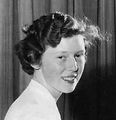 Delia in 1955
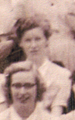 Delia in 1956
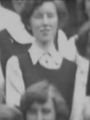 Delia at school
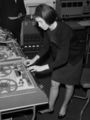 Delia (in 1962/63?)
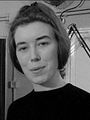 Delia in 1964/65
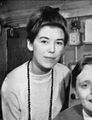 Delia on 25th March 1965
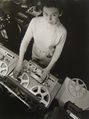 Delia in 1965
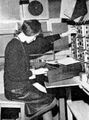 Delia in Autumn 1965
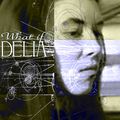 Delia in the late 1960s or early 70s
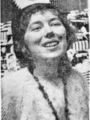 Delia in 1970
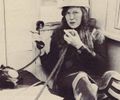 Delia as a radio operator
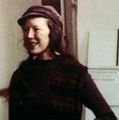 Delia in the 1970s
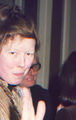 Delia in 1978
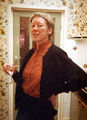 Delia in 1986
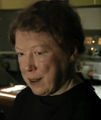 Delia in 1993
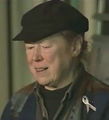 Delia in 1998


